News
Why Stable Formulation Matters in Textile Printing Production
For textile printers, producing a successful laboratory sample is only the first step.
The greater challenge is ensuring that the same printing result can be reproduced consistently when the order moves into mass production.
Small differences in viscosity, raw materials, formulation ratios or production conditions can affect printability, print thickness, hand feel, adhesion and final appearance.
Reliable printing-material manufacturing therefore requires more than simply mixing raw materials. It requires a complete process covering formulation development, sample validation, performance testing and scaled manufacturing.
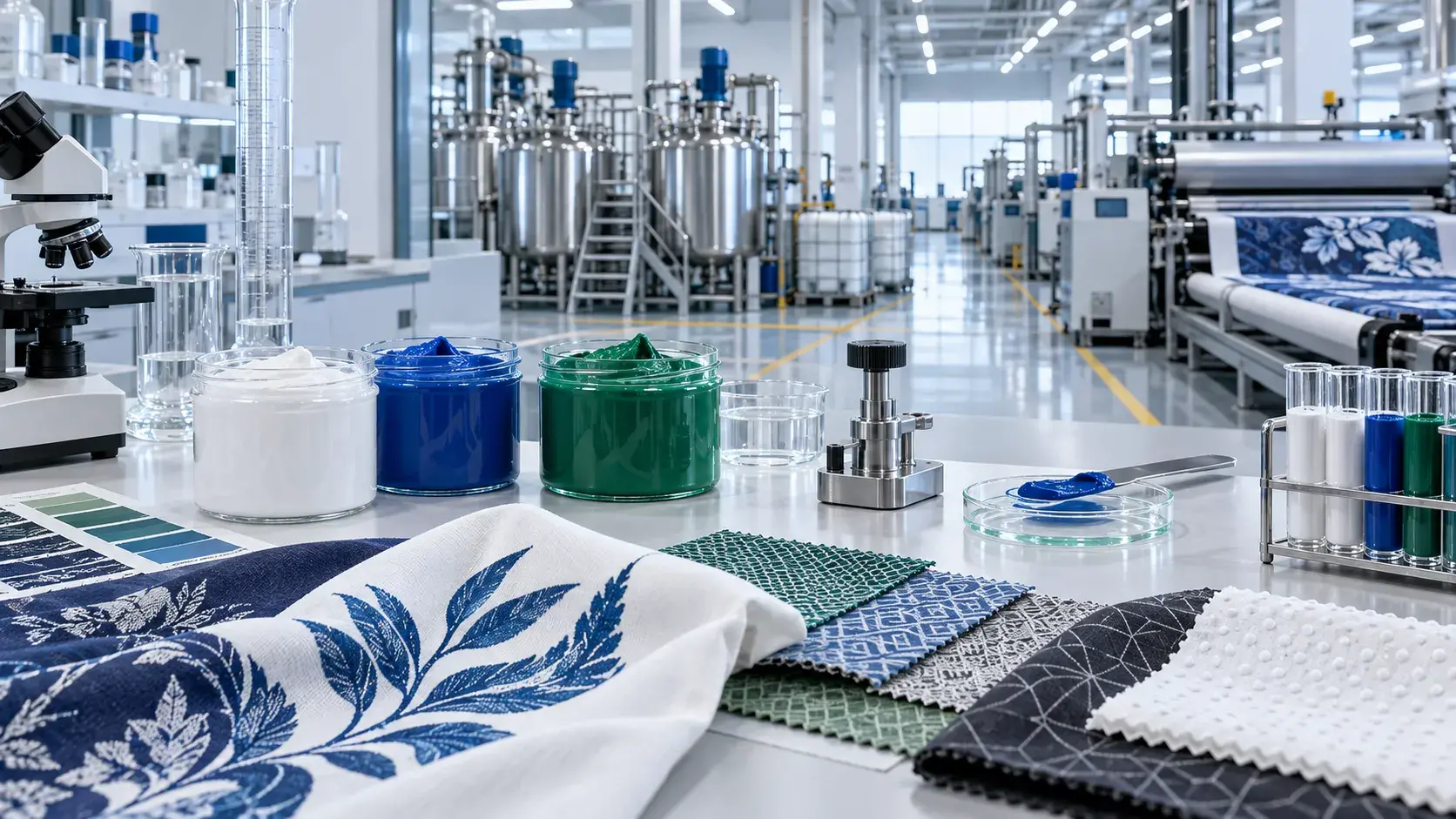
Zhuancai operates professional R&D facilities together with scaled production equipment, creating a complete process from laboratory development to commercial manufacturing.
It Starts With the Right Formulation
Different printing effects require very different material properties.
A high-density paste needs to create clear dimensional layers.
A puff paste must expand predictably during heating.
A flocking paste requires reliable bonding performance.
A PU Lycra paste needs flexibility for elastic fabrics.
Anti-migration materials need to help control dye migration on difficult substrates.
For this reason, effective formulation development should begin with the intended application rather than with a generic printing paste.
Zhuancai’s portfolio currently covers 13 product series for a wide range of textile printing processes and effects.
Sample Validation Helps Reduce Production Risk
Before a new formulation moves into scaled production, it should first be evaluated through practical printing trials.
Some problems cannot be fully identified through laboratory measurements alone.
For example, a paste may have acceptable viscosity but still show poor printing behavior on a particular screen or machine.
Another material may look correct immediately after printing but behave differently after curing, stretching or washing.
Sample validation helps identify these issues before commercial production begins.
Performance Testing Should Match the Application
Different printing materials require different performance evaluations.
Typical considerations include adhesion, elasticity, abrasion resistance, wash performance, hand feel and surface appearance, as well as migration resistance, yellowing resistance or flex resistance where relevant.
Zhuancai’s product catalogue also shows that different product series are developed around different performance priorities rather than one universal specification.
From Laboratory Development to Scaled Manufacturing
The transition from laboratory preparation to industrial-scale manufacturing is a critical stage in printing-material production.
Equipment size, mixing conditions, material feeding and production volume can all influence final material behavior.
A standardized manufacturing process helps ensure that commercial products remain consistent with the formulation and performance established during laboratory development.
For textile printers, more consistent materials can mean fewer machine adjustments, less repeated testing and reduced batch-to-batch variation.